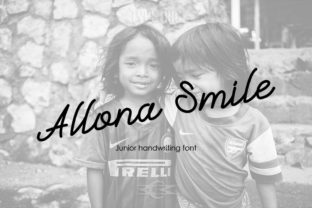
Allona Smile: A Handwritten Font with Childlike Charm
Last week, I found myself hunched over the kitchen table, tweaking label designs for a new batch of lavender soy candles. I had been using a generic free font that felt flat and impersonal. I wanted something that felt like a handwritten note from the maker—a face that could turn a simple glass jar into a gift-worthy keepsake. That’s when I stumbled upon the Allona Smile font, a script handwritten typeface that completely changed the way I think about small-batch packaging. At first glance, Allona Smile looks like it was penned by a child with a remarkably steady hand. The letterforms are slightly irregular, full of gentle curves and a bouncy baseline that feels cheerful without being messy. It has a natural writing style inspired by children’s writing, yet it’s surprisingly easy to read—great readability is rare in playful script handwritten fonts. This balance makes Allona Smile versatile for project designs for children and teen apparel, but also for more grown-up handmade businesses that need a touch of warmth.
Allona Smile for Product Labels and Handmade Packaging
When I applied the Allona Smile handwritten font to my candle labels, the script handwritten style immediately softened the entire look of the glass jar. The fragrance name ‘Lavender Fields’ looked as if I had penciled it myself, and that personal touch gave the product an artisan feel that a cold, sans serif font never could. For small businesses selling skincare, baked goods, or boutique candles, a display font like this one can replace costly custom calligraphy. I used it as the hero text on a frosted jar with a simple kraft label, and it instantly elevated the brand identity from hobbyist to polished maker.
Because Allona Smile is so readable, I was able to pair it with a clean sans serif font for the ingredient list and net weight. That contrast—playful script for the headline, neutral sans for tiny details—created a professional hierarchy without sacrificing warmth. If you sell handmade soap bars, artisanal honey, or frosted cookie boxes, a commercial font like this can become the quiet centerpiece of your packaging design. Just remember to keep the printed size above 10 point, because even though the letters are clear, the irregular stroke width can narrow on flyaway curls when shrunk too far.
Using Allona Smile on Instagram Templates and Social Media Graphics
One of the most practical tests for any modern script handwritten font is how it performs on social media graphics, and Allona Smile held up beautifully on my shop’s Instagram story templates. I created a sale announcement slide with a soft blush background, a single product photo, and the phrase ‘New batch ready—hand poured with love’ set in this premium font. Even on a small mobile screen, the natural writing style felt friendly and scroll‑stopping. Because Allona Smile carries the lightness of children’s writing, it worked especially well for thank‑you posts and behind‑the‑scenes reels where I wanted the message to feel intimate, not corporate.
For online shop banners and Pinterest pins, I found that the font maintained its charm at larger display sizes. It paired wonderfully with airy product photography because the slightly organic letter shapes didn’t fight the image for attention. One tip: when designing social media graphics that include a short quote or a product name, use Allona Smile as the focal point and support it with a lightweight sans serif like Montserrat or Lato for any secondary text. That approach keeps your brand identity consistent across posts and prevents the feed from feeling chaotic.
Pairing Allona Smile with Sans Serif Fonts for Menus and Flyers
If you run a café or a children’s boutique and want to use Allona Smile as a menu font, pairing it with a clean sans serif font is the secret to keeping everything legible. I tested a mock‑up of a seasonal brunch menu: ‘Sunny Side Pancakes’ in Allona Smile as the header, with ‘served with maple butter and fresh berries’ beneath it in a sturdy sans serif font like Open Sans. The contrast was effortless. The handwritten header gave the board a cozy, family‑friendly vibe, while the smaller body copy stayed crisp enough for a server to read in dim light. This type of modern typography combination works just as well on flyers for school fairs or street market stalls.
For boutiques, a hang tag with the shop name in Allona Smile and the size or material in a petite serif font can feel both charming and trustworthy. Avoid setting entire paragraphs in the script; its strength lies in display text—short phrases, product titles, and decorative accents. That way, you harness the childlike warmth without sacrificing functionality, which is exactly what a small business needs when every customer interaction counts.
Is Allona Smile the Right Font for a Children’s Clothing Line?
The Allona Smile font was inspired by children’s writing, so it naturally fits into any script handwritten collection for playful brands. When I mocked up a unisex tee shirt for a hypothetical kids’ line, the word ‘Adventure’ in Allona Smile looked like a little one had scrawled it across the front. It would be equally at home on nursery wall art, storybook covers, or birthday party invitations. For a children’s clothing brand, using a handwritten font like this on woven labels or inside neckline prints can reinforce a sense of playfulness that parents associate with authenticity.
However, if you plan to use Allona Smile in a logo design for a children’s brand, consider keeping the brand name short. The bouncy baseline and irregular spacing add personality, but a long business name may start to feel cluttered. For anything beyond three words, it’s safer to pair the script with a clean, structured serif or sans serif font. When I tested it on a mock hang tag with care instructions in 7‑point type, the readability dropped noticeably, so reserve Allona Smile for the main statement and let a simpler typeface handle the fine print.
Readability Tips and Commercial Licensing for Small Business Branding
Before you use any script handwritten font on product packaging, it’s essential to test its readability at small sizes—and Allona Smile performed decently, but with some caveats. The hand‑drawn quality that makes it so charming can also cause certain letter pairs to tighten up, so I recommend checking three things:
- Zoom out to 50% on your design software and see if the word still reads as intended.
- Proof all descenders and ascenders; the playful bounce can overlap if line spacing is too tight.
- Use Allona Smile at 14‑point or larger on print materials, and at least 16‑point on digital graphics, to retain its legible shape.
This font shines as a display font for headlines, logos, packaging titles, and short emotional phrases. It is not designed for long body copy, so keep it to accents and hero elements. I also suggest looking into the font files themselves: check for included alternates, ligatures, and multilingual support if your customer base extends beyond English. Since Allona Smile is a creative font you may want to use on merchandise, digital downloads, or client work, always verify the commercial font licensing. A standard desktop license often covers physical goods, but if you plan to embed the font in a logo template sold online, make sure the EULA permits digital redistribution. Small business owners who get the licensing right can use Allona Smile confidently across everything from thank‑you cards to email newsletter banners.
After a month of using Allona Smile across my candle labels, thank‑you notes, and Instagram stories, the font has become a quiet workhorse in my brand kit. It’s not loud or trendy—it’s genuine, warm, and disarmingly readable. For any small business that wants to feel more handmade and human, this font is a gentle upgrade that customers notice, even if they can’t quite put their finger on why.